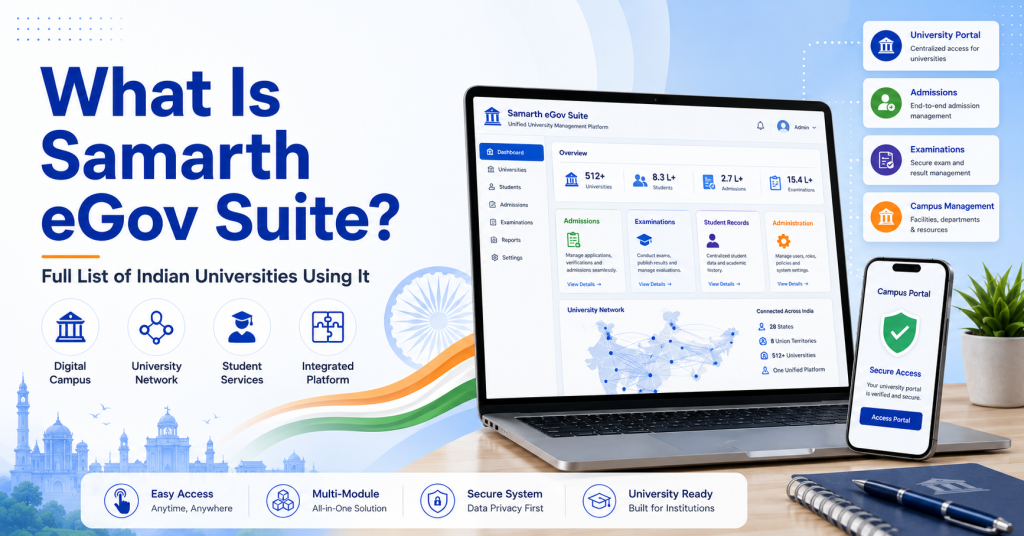
What Is Samarth eGov Suite? Full List of Indian Universities Using It
If you’ve noticed that several different universities all seem to use a portal that looks and behaves similarly, you’re not imagining it. They’re all running on the Samarth eGov Suite, a shared software framework rather than one single website. This guide explains what it actually is, why so many Indian universities have adopted it, which ones you’re likely to come across, and what it means for you as a student navigating one of these systems day to day.
What Is the Samarth eGov Suite
Samarth eGov Suite is a set of software modules built to help higher education institutions in India digitise their administrative and academic processes – admissions, registration, examinations, fee collection, and more – under one connected system. Rather than each university building its own software from scratch, Samarth provides a common technical base that individual institutions customise and deploy under their own branding and domain. That’s why the login screens across different universities look structurally similar but carry different colours, logos, and specific menu wording, sometimes to the point where students switching between two university portals barely notice they’re using a different system at all.
Why So Many Universities Adopted the Same System
Building and maintaining a full academic ERP system from the ground up is expensive and technically demanding for any single university. A shared framework like Samarth lets institutions benefit from a tested, continuously updated system without each one reinventing the same functionality independently. It also makes a degree of standardisation possible across India’s higher education sector, even though each university still runs its own separate, independent instance with its own student data.
What the Samarth Portal Typically Handles
Not every university enables every module; some use Samarth mainly for examinations and results while handling admissions through a separate system, while others run nearly their entire student lifecycle through it.
Core Modules Covered by Samarth eGov Suite
Academic Lifecycle Functions
- Student registration and re-registration each academic session
- Admission-related formalities once a seat is confirmed through counselling or merit lists
- Exam form submission and fee payment
Records and Documentation Functions
- Result declaration and marksheet access
- Admit card generation and download
- Certain administrative requests like migration certificates and transcripts
Universities Commonly Associated With Samarth Portal
The list of Indian universities using some version of the Samarth eGov Suite is extensive and continues to grow.
Frequently Searched Samarth Portal Universities
Some of the more frequently searched examples include:
| University | Region | Common Portal Focus |
|---|---|---|
| Chhatrapati Shahu Ji Maharaj University (CSJMU) | Kanpur, Uttar Pradesh | Registration, exam forms, results |
| University of Lucknow | Lucknow, Uttar Pradesh | Registration, admission, exam forms |
| Banaras Hindu University (BHU) | Varanasi, Uttar Pradesh | Registration, results, student services |
| University of Allahabad | Prayagraj, Uttar Pradesh | Registration, exam forms (admission via CSAS) |
| Chaudhary Charan Singh University (CCSU) | Meerut, Uttar Pradesh | Registration, exam forms, admit cards |
| Deen Dayal Upadhyaya Gorakhpur University (DDU) | Gorakhpur, Uttar Pradesh | Registration, exam forms, results |
| Maharshi Dayanand University (MDU) | Rohtak, Haryana | Registration, exam forms, results |
| Dr. Ram Manohar Lohia Avadh University (RMLAU) | Ayodhya, Uttar Pradesh | Registration, exam forms, results |
| Gauhati University | Guwahati, Assam | Registration, results |
| Gujarat University | Ahmedabad, Gujarat | Registration, exam forms |
| University of Mumbai | Mumbai, Maharashtra | Registration, results |
| Pondicherry University | Puducherry | Registration, exam forms, results |
| IGNOU | New Delhi (nationwide, distance learning) | Admission, exam forms, results |
| Veer Bahadur Singh Purvanchal University (VBSPU) | Jaunpur, Uttar Pradesh | Registration, exam forms, results |
This is a representative sample rather than an exhaustive list; dozens more state and central universities across India run their own Samarth instances, each with its own login and specific rules.
North Indian Universities on Samarth
Uttar Pradesh alone accounts for a large share of Samarth adoption among the examples above, including CSJMU, University of Lucknow, BHU, Allahabad University, CCSU, DDU Gorakhpur, and RMLAU, alongside MDU in neighbouring Haryana.
Other Regional Examples
Gauhati University in Assam, Gujarat University, University of Mumbai, and Pondicherry University represent the system’s spread well beyond the Hindi-speaking states, alongside IGNOU’s nationwide distance-learning reach.
How to Check If Your University Uses Samarth
- Visit your university’s official website directly, rather than searching generically.
- Look for a “Student Login,” “Samarth Portal,” or “ERP” link in the main navigation.
- If the login page structure – registration number, password, captcha – looks familiar and mentions Samarth or eGov Suite anywhere on the page, your university is very likely using this framework.
- If you’re still unsure, your college’s admission or exam office can confirm directly and give you the exact link to use.
Samarth Portal vs University-Specific ERP Systems
Not every Indian university uses Samarth specifically; some maintain entirely custom ERP systems built independently, which is why a portal like AKTU’s ERP looks and behaves somewhat differently from a typical Samarth-based system, even though it serves a similar overall purpose. If you’re trying to figure out whether your specific university’s portal is Samarth-based or an independent system, the practical difference for you as a student is usually minor since the core actions – registration, exam forms, results – work in broadly similar ways either way.
Government Backing and the Bigger Picture
Samarth eGov Suite ties into India’s broader push toward digitising higher education administration, part of a wider effort to standardise how student records, examinations, and institutional data are managed across the country’s large and varied higher education system. For students, the practical benefit is straightforward: fewer physical visits to exam sections and admission offices for routine tasks that can now be handled online, even if the systems occasionally frustrate with slow loading during peak traffic or the login confusion that comes with dozens of similar-looking portals across the country.
What Changes for Students When a University Adopts Samarth
For students who were enrolled before their university switched to Samarth, the transition period can feel a little disorienting. Older academic records sometimes need manual migration into the new system, which occasionally causes gaps or mismatches in historical data, particularly for students who were mid-course when the switch happened. If you notice missing older semester results or an unusual data format compared to more recently admitted students, this is typically a migration issue from the transition period rather than a new problem with your account. It’s usually resolved through a written request to your university’s examination department rather than standard portal troubleshooting.
Practical Tips for Navigating Any Samarth-Based Portal
Since so many universities run some version of this system, a few general habits apply almost universally, regardless of which specific university’s portal you’re using:
- Always start from your university’s official website rather than a search result, to avoid landing on the wrong institution’s portal by mistake.
- Complete registration, exam forms, and other time-sensitive actions a few days before the deadline, not on the final day, since traffic spikes sharply close to any cutoff across all Samarth-based systems.
- Keep your registration number, password, and registered contact details updated and noted somewhere accessible, since these are your lifeline for both daily login and emergency password recovery.
- Use a laptop or desktop for document-heavy actions like registration, since mobile browsers handle file uploads less reliably.
- Screenshot every important confirmation – registration, exam form, fee payment – as proof in case a records dispute comes up later.
How This Fits Into India’s Broader Digital Education Push
The move toward systems like Samarth reflects a wider shift across Indian higher education toward reducing manual, paper-based processes for routine student administration. For a country with as many universities and as large a student population as India’s, a shared, adaptable framework makes it more feasible for institutions, especially smaller state universities with limited technical budgets, to offer reasonably modern digital services to their students without each one building everything from scratch. The trade-off students sometimes experience – slow loading during peak deadlines, or confusion between similarly designed portals from different universities – is largely a side effect of scale rather than a flaw specific to any one institution’s implementation.
Frequently Asked Questions
Is Samarth Portal a single website used by all universities?
No. It’s a software framework that individual universities each deploy as their own separate, independently managed instance, with their own login, student data, and domain.
How many universities in India use Samarth eGov Suite?
The number continues to grow and spans a wide mix of state and central universities across multiple states, though there’s no single centrally published, continuously updated public count that covers every recent adoption.
Can I use my login from one Samarth-based university at a different one?
No, each university’s instance is entirely separate, with its own independent student database. A login from one university has no validity or meaning on another university’s system.
Is Samarth Portal government-run or privately built?
It originates from an initiative tied to India’s higher education digitisation efforts, though each university independently deploys, customises, and manages its own instance of the system.
Why do some universities have very different-looking portals despite both using Samarth?
Each university customises its own instance’s branding, colour scheme, and specific menu wording, so even though the underlying technical framework is shared, the visual presentation can differ noticeably.
My university isn’t on the table above. Does that mean it doesn’t use Samarth?
Not necessarily. The table lists commonly searched examples rather than a complete list. Check your university’s official website directly for the most accurate, current information about which system it uses, since adoption has continued to expand across more institutions over recent years.
Note: adoption of Samarth eGov Suite and its specific modules can change over time as universities update their systems. Always confirm your specific university’s current setup through its official website.
Related reading: Samarth Portal Login: Complete Step-by-Step Guide, Samarth Portal Registration Guide, and CSJMU Samarth Portal Guide.